

Manassas (1861-1862)
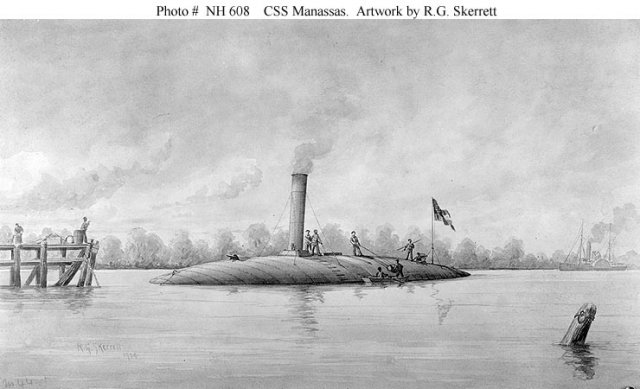
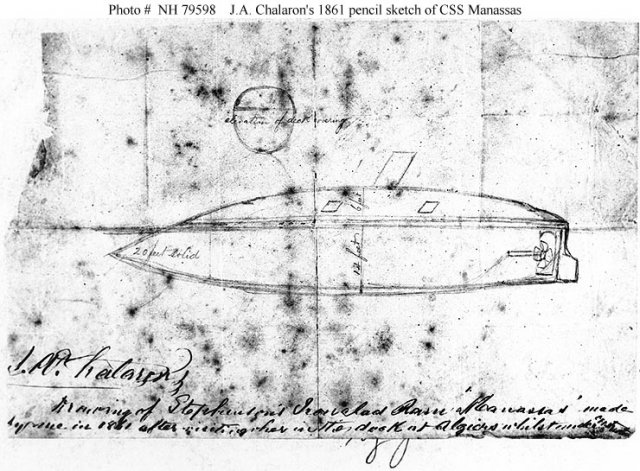
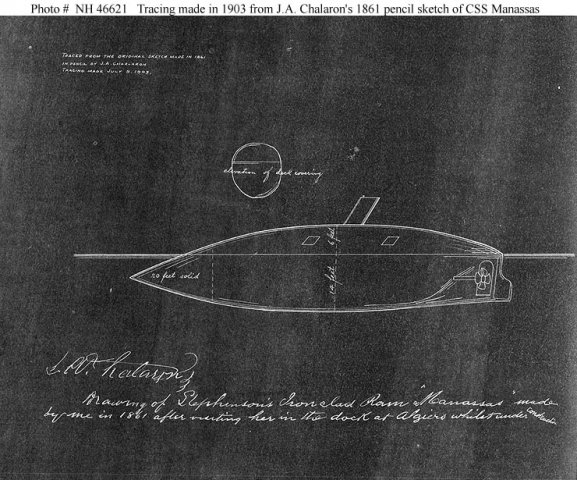
CSS Manassas, a 387-ton ironclad ram, was originally built at Medford, Massachusetts, as the screw towboat Enoch Train. Purchased in 1861 by Captain John A. Stevenson of New Orleans, she was converted to a warship at Algiers, Louisiana. Her above-water hull was reshaped to a "turtle-back" form and covered with iron plating. She was given a pointed iron ram at the bow and carried a single gun that fired forward through a small opening. Her low profile made her a difficult target, while her armor protected her against all but the most well-directed enemy gunfire.
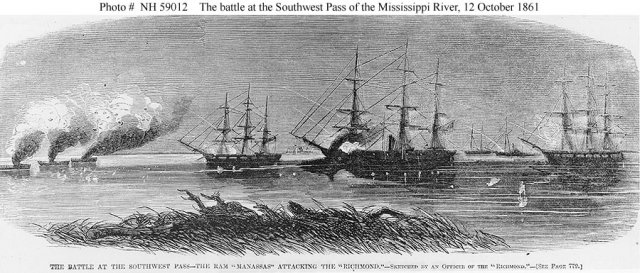
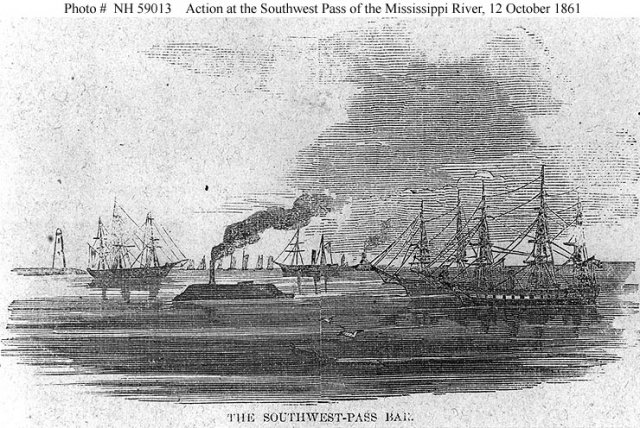
Placed in privateer service in September 1861, Manassas was soon taken over by the Confederate Navy and was formally purchased by the Government in December 1861. On 12 October of that year, she attacked the Federal blockading force at the Mississippi River's Head of Passes. The big steam sloop USS Richmond was rammed and seriously damaged, but survived. Manassas was also damaged, mainly by the force of her own ramming effort, but successfully withdrew and was repaired.
Continuing her employment with the Confederacy's defenses on the Lower Mississippi, Manassas played a dramatic role in the major battle that took place during the night of 24 April 1862, when U.S. Navy Flag Officer David Glasgow Farragut boldly took his squadron up the river past Confederate Forts Jackson and Saint Philip to capture New Orleans. During the action off the forts, Manassas attacked the large Union warships Pensacola, Mississippi and Brooklyn. She was able to ram the last two, though not fatally, before running aground. USS Mississippi then disabled her with withering cannon fire. Abandoned and afire, Manassas drifted downstream, exploded and sank.
This page features, or provides links to, all our views concerning CSS Manassas.
For pictures relating to CSS Manassas' participation
in the naval battle off Forts Jackson and St. Philip, see:
|
Photo #: NH 608 CSS Manassas (1861-62) Wash drawing by R.G. Skerrett, 1904. |
 |
|
Photo #: NH 79598 CSS Manassas (1861-1862) Pencil sketch made by J.A. Chalaron in 1861, after he had visited the ship while she was under conversion in dock at Algiers, Louisiana. Donation of Major General Jim Dan Hill, U.S. Army (Retired), 1964. |
 |
|
Photo #: NH 46621 CSS Manassas (1861-1862) Blueprint reproduction of a tracing made 9 July 1903 from the original 1861 pencil sketch by J.A. Chalaron. |
 |
|
Photo #: NH 59012 "The Battle at the Southwest Pass -- The Ram 'Manassas' attacking the 'Richmond.' -- Sketched by an Officer of the 'Richmond'." Line engraving published in "Harper's Weekly", 1861, depicting CSS Manassas attacking USS Richmond near the Head of Passes, Mississippi River, on 12 October 1861. Other ships depicted include the U.S. sailing sloops of war Vincennes and Preble (in left center and at right). |
 |
|
Photo #: NH 59013 "The Southwest-Pass Bar." Line engraving published in "Harper's Weekly", 1862, depicting the Federal blockading fleet near the mouth of the Mississippi River. Also shown, in left center, is what appears to be CSS Manassas. She attacked Union warships at Southwest Pass on 12 October 1861. |
 |
|
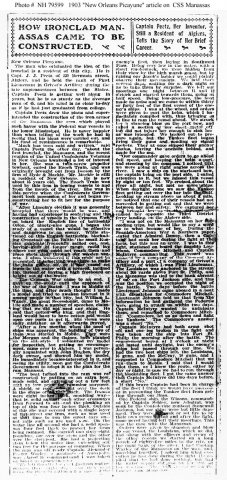
Photo #: NH 79599 CSS Manassas (1861-1862) Newspaper article from the "New Orleans Picayune", 1903, giving Captain J.J. Peetz' account of the ship's construction and career. Donation of Major General Jim Dan Hill, U.S. Army (Retired), 1964. Online Image: 354KB; 580 x 1225 pixels |
 |
|
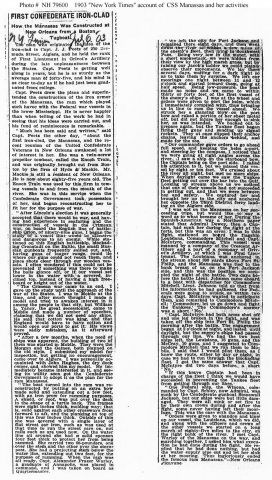
Photo #: NH 79600 CSS Manassas (1861-1862) Newspaper article from the "New York Times", 6 July 1903, on the ship's construction and career, as related by Captain J.J. Peetz. The piece had originally appeared in the "New Orleans Picayune" (see Photo # NH 79599). Donation of Major General Jim Dan Hill, U.S. Army (Retired), 1964. Online Image: 366KB; 695 x 1225 pixels |
 |
|
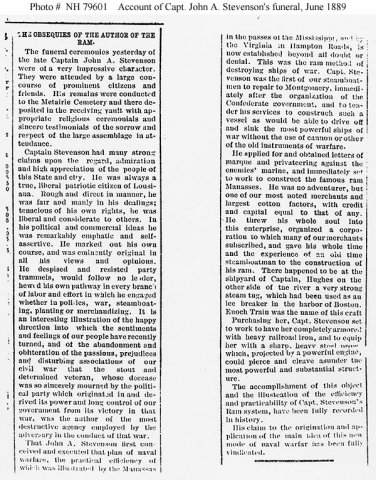
Photo #: NH 79601 Captain John A. Stevenson Account of his funeral, from a New Orleans, Louisiana, newspaper of 30 June 1889. He was the builder and original owner of CSS Manassas (1861-62). Donation of Major General Jim Dan Hill, U.S. Army (Retired), 1964. |
 |
For pictures relating to CSS Manassas' participation
in the naval battle off Forts Jackson and St. Philip, see: